



.webp)

How Unfocused Social Media Marketing Impacts Your Brand Trust
.jpg)

Digital marketing is changing faster than ever. Businesses used to be solely concerned with their Google rankings. Today's conversation has shifted to AI-powered search experiences. This shift has brought a new concept to the marketing world: GEO (Generative Engine Optimization).
So, the big question is: SEO vs GEO: Which strategy wins in modern digital marketing? Is traditional SEO still relevant, or is GEO the future?
Let's break it down in a straightforward, practical, and realistic manner.
Search Engine Optimization (SEO) is the practice of improving your website and content so it ranks higher in search engines like Google. The goal is clear: boost organic traffic by making your pages easier to find in search results.
SEO includes:
The impact of these SEO efforts is reflected in measurable performance indicators. Consistent keyword research and on-page optimization expand the number of ranking terms, which drives growth in organic keywords and search visibility. Technical improvements and user-experience enhancements strengthen site health and engagement, contributing to higher authority scores and traffic share. Meanwhile, strategic link building and content promotion increase referring domains and backlinks, amplifying domain credibility and organic reach.
As a result, SEO performance can be seen in metrics such as authority score, organic traffic, ranking keywords, and backlink profile - all of which demonstrate how sustained optimization translates into scalable, long-term search growth.

Companies invest in SEO because organic traffic builds lasting visibility and trust - and it lowers reliance on paid advertising. It’s still one of the most cost-effective marketing channels available.
Generative Engine Optimization (GEO) is an emerging approach that helps your content perform well in AI-powered search and generative tools like ChatGPT, Google SGE, and other assistants.
Rather than focusing only on traditional search rankings, GEO aims to:
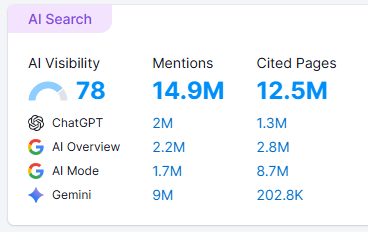
The impact of GEO efforts is reflected in emerging AI search performance metrics. Structuring content for clear interpretation and aligning it with conversational intent increases the likelihood of being cited in AI-generated answers, which contributes to growth in cited pages and brand mentions. Optimizing for conversational queries and contextual relevance improves visibility across AI search interfaces such as ChatGPT, AI Overviews, and Gemini.
As a result, GEO performance can be evaluated through indicators like AI Visibility score, total mentions, and cited pages - demonstrating how well a brand is recognized, referenced, and surfaced within AI-driven search ecosystems.
Traditional SEO often centers on keywords and rankings. GEO prioritizes clear meaning, credibility, and topic relevance.
As AI search becomes more common, people increasingly get answers without visiting multiple websites. That shift makes the SEO vs. GEO conversation more important for businesses.
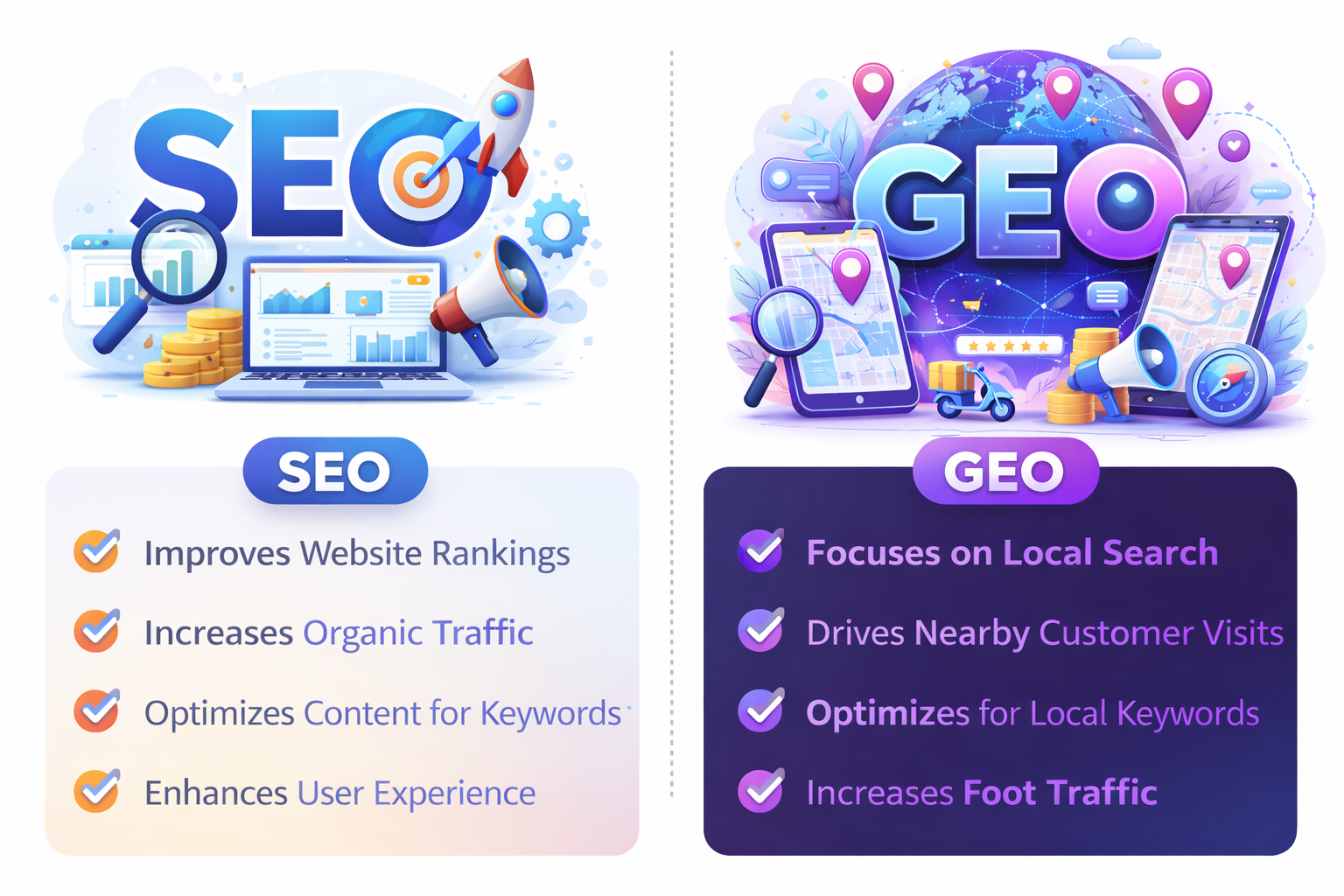
Understanding the difference between SEO and GEO helps you decide which approach to focus on.
SEO and GEO support different search habits - and many brands benefit from using both.
Many marketers ask, “Is SEO dead?”
No, SEO isn’t going away - it’s changing. Google still handles billions of searches every day, and businesses still rely on organic traffic to drive leads and sales. Strong search rankings remain essential for visibility and trust.
What’s changing is how people search. With AI-powered search, users ask full, conversational questions instead of short keyword phrases. Content strategies need to reflect that shift.
The conversation shouldn’t be “SEO vs. GEO.” It should be about how they work together.
GEO is gaining traction because AI-driven search experiences are expanding fast. Many platforms now summarize information, make recommendations, and generate answers instantly.
GEO matters because:
For example, when someone asks an AI tool, “What’s the difference between SEO and GEO?” it may provide a direct answer instead of a list of links.
If your content is GEO-ready, your brand is more likely to be cited in those AI-generated answers.
That’s why the SEO vs. GEO conversation will matter even more in 2026 and beyond.
The most effective digital marketing approach isn’t picking one tactic instead of the other. It’s integrating both.
Here’s how to improve SEO and GEO at the same time:
Create detailed, credible content that responds to real user questions. AI systems favor content that is structured, educational, and clearly organized.
Rather than cramming in keywords, use a conversational tone. This boosts classic SEO results and strengthens GEO discoverability.
Know if people want information, comparisons, or buying guidance. Content built around intent tends to perform better across SEO and GEO.
Release several pieces around connected subjects. This builds site authority and reinforces trust signals for AI.
Site speed, mobile-friendly design, and structured data still count. Even AI engines depend on technically reliable pages.
In the SEO vs GEO discussion, the best path is smart alignment - not rivalry.
So, in the battle of SEO vs GEO, which approach actually comes out on top?
The real answer is: whichever one can adjust and evolve.
SEO still fuels steady, long-term organic growth. GEO signals the next wave of AI-powered discovery. Companies that overlook SEO may lose critical search visibility. Companies that overlook GEO may miss new opportunities emerging inside generative AI platforms.
Today’s digital marketing isn’t about picking SEO vs GEO as if only one can work. It’s about recognizing how audiences are changing the way they search and then aligning your content to meet them where they are.
Treat SEO as the base layer and GEO as the next step forward.
As we move forward, search is becoming more tailored, more conversational, and more influenced by AI. Over time, SEO will likely blend with key GEO ideas.
We can expect:
Brands that publish helpful, people-first content will perform well in both traditional search and generative engines.
In the end, the SEO vs GEO debate points to a simple truth: marketing keeps evolving, but content still rules.
Looking for expert SEO, GEO, or complete digital marketing services? We help businesses increase visibility, traffic, and conversions.
Contact us:- https://beyondjustservice.com
